First published in February 2022 – Last edited in September 2022 by Luka Tunjic. © All rights reserved.
The analysis of the consequences of weight loss surgery (bariatric surgery) further indicates that the changes in breathing biomechanics cause the remission of Type 2 diabetes, thus, indicating that the faulty breathing biomechanics cause Type 2 diabetes.
Mechanisms Responsible for Excess Weight Loss after Bariatric Surgery … “bariatric surgery, the most successful clinical intervention known for treating obesity. Surgery can result in impressive weight loss and improvement of obesity-related comorbidities.” … “It is now clear that caloric restriction, per se, does not explain all the reduction in stored fat mass after surgery.”
Ionut V, Bergman RN. Mechanisms responsible for excess weight loss after bariatric surgery. J Diabetes Sci Technol. 2011 Sep 1;5(5):1263-82. doi: 10.1177/193229681100500536. PMID: 22027328; PMCID: PMC3208891.
People involved in marketing bariatric surgery (weight loss surgery, like to mention weight loss after bariatric surgery, but at the same time, they distanced themselves from it by renaming weight loss surgery to bariatric surgery and, recently, to Metabolic surgery.
According to numerous published studies after bariatric surgery (weight loss surgery), diabetes mellitus type 2 is reversible in up to 90% of patients; this leads to normal blood sugar levels without medication, sometimes within days after surgery.
“The changes in insulin resistance seen after gastric bypass, which are responsible for the resolution or improvement of type 2 diabetes occur within 6 days of the surgery, before any appreciable weight loss has occurred.”
Wickremesekera K, Miller G, Naotunne TD, Knowles G, Stubbs RS. Loss of insulin resistance after Roux-en-Y gastric bypass surgery: a time course study. Obes Surg. 2005 Apr;15(4):474-81. doi: 10.1381/0960892053723402. PMID: 15946424. https://pubmed.ncbi.nlm.nih.gov/15946424/
Suppose obesity or excessive fat mass around the abdomen causes type 2 diabetes. The weight loss or fat loss around the waist could be linked to a diabetes cure if that’s the case. However, this is not the case because, after bariatric surgery (weight loss surgery), diabetes type 2 reverses before any fat mass loss or, in some cases, before the significant fat mass loss occurs.
The other fact is that around 10% to 15% of people with type 2 diabetes are at a healthy weight. On the other hand, not all overweight and obese people have Type 2 diabetes.
Analysis of the consequences of bariatric surgery and its effect on breathing biomechanics reveals the mechanism behind the remission (cure) of Type 2 diabetes following bariatric surgery (weight loss surgery).
The text below explains how the side effects (consequences) of weight loss surgery (Bariatric Surgery) cause remission of type 2 diabetes by changing the breathing biomechanics.
The consequences of bariatric surgery (weight loss surgery) are:
1) Obesity surgery leaves a wound in the abdominal wall and the stomach.
2) The abdominal wall wound heals in a matter of days, but the stomach wound takes much longer and sometimes fails to heal.
3) Even when the abdominal wall and stomach wound have healed, there are still staples, bands, etc., in the abdomen.
Because of the stomach wounds, patients must maintain a posture that enables the abdominal cavity to be as large as possible; otherwise, the wound area will become compressed. When the stomach wound becomes compressed, the patient experiences increased strain or pain in the stomach.
Before weight loss surgery, a patient (habitual breathing) breathed mainly with the belly, which expands outward during inhalation and shrinks inward during exhalation. Therefore, only the abdominal muscles are involved in breathing, and the other muscles in the trunk and neck are mainly inactive during inhalation and exaltation. The pancreas is in the abdomen (belly). Breathing primarily with the belly overstimulates the pancreas, causing it to produce an abnormal amount of insulin. (Note! It is wrong to assume that a body is insulin resistant. The body uses some insulin but doesn’t use all the insulin produced by the pancreas because the pancreas makes more insulin than the body needs.)
After bariatric surgery (weight loss surgery), breathing with the belly and lover part of the abdomen gets painful, forcing the patient subconsciously to change the breathing technique by breathing less with the belly but more with the chest. Note! We are breathing with the lungs. So-called “belly breathing means that mainly the abdominal cavity expands during inhalation and shrinks during exhalation. At the same time, it means that primarily the muscles in the abdomen are involved in breathing, but the other muscles (in the chest, neck, and upper back) are mainly inactive during breathing.
The pain causes the patient to subconsciously change the breathing technique (breathing biomechanics) by breathing less with the tummy and more with the upper trunk, causing the middle and primarily the upper trunk (chest area) to expand outward and upward during inhalation and shrink inward during exhalation. (Note! When the chest area expands upward, the abdominal area expands upward. By contrast, breathing from the abdomen causes the abdomen to expand only outward, not upward).
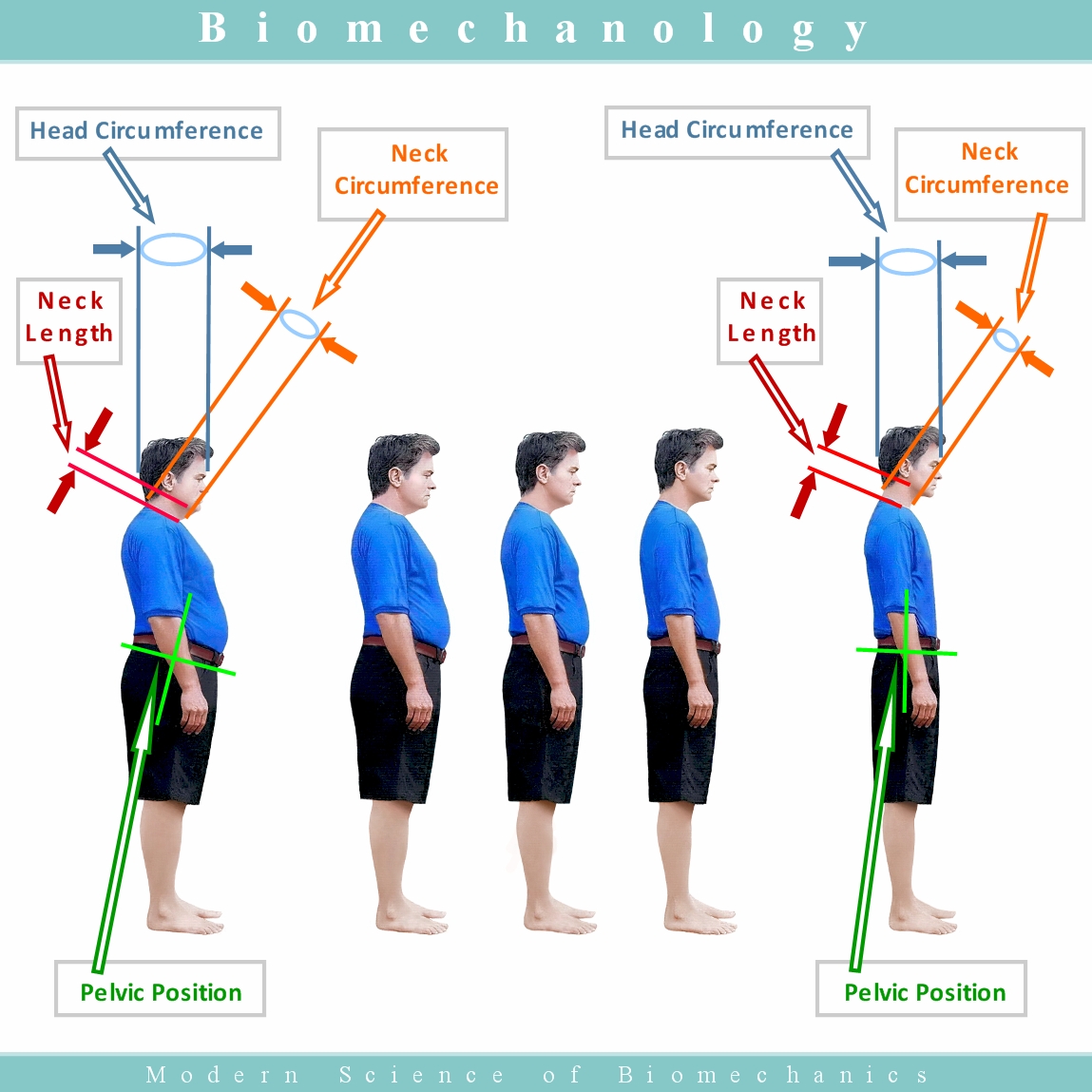
After some time, when the wound has healed, the staples, lap band, etc., in the stomach patient still doesn’t breathe primarily in the belly; otherwise, the presence of surgical staples and altered stomach anatomy will cause increased pain in the abdomen. A slouched-hunched body posture in a sitting and standing position reduces the distance between the bottom of the rib cage and the top of the pelvic bone, thus compressing the abdominal cavity. At the same time, it impairs the upper chest breathing muscle’s function. Rolled pelvis backwards when sitting impairs the breathing muscles in the upper part of the trunk. (Rolling the pelvis backwards in a sitting position compresses the abdominal cavity and simultaneously impairs the upper chest breathing muscle’s function.) After obesity surgery, sitting with the pelvis rotated fully backwards will produce discomfort or pain in the abdomen.
One of the consequences of obesity surgery is that it forces a patient to maintain a posture that doesn’t cause compression of the abdominal cavity. On the other hand, it causes the abdominal muscles to be physically active even when a patient sits on a chair with a soft seat and sits on a couch, sofa, or armchair. (The consequences of obesity surgery force the abdominal muscles’ constant upward-lifting activity.)
Note! On the one hand, weight loss surgery causes a decrease in overall physical activity and improves the efficiency of locomotion. On the other hand, it causes an increase in the abdominal muscles’ upward-lifting activity. The abdominal muscles’ physical activity increases without increasing breathing or heart rate.
Optimal breathing biomechanics is possible only by attaining a good body posture. (In most cases, the patient can’t achieve an ideal body posture even after weight loss surgery. Still, the wound and later surgical staples and altered anatomy of the stomach force to maintain a much better body posture than before obesity surgery, resulting in improved breathing biomechanics.)
The change in breathing (breathing biomechanics) causes the remission (or cure) of Type 2 diabetes after weight loss surgery-bariatric surgery.
a) It is not obesity that causes mechanical compression of the diaphragm, lungs, and chest cavity. b) The poor posture, like rounded back posture, alone or in combination with adverse musculoskeletal conditions, causes mechanical compression of the diaphragm, lungs, and chest cavity and impairs specific breathing muscles activity. At the same time, it causes excessive weight gain, which is distributed mainly in the chest (gynecomastia) and waistline area.
Note! Bariatric surgery (Weight Loss Surgery) causes some improvement in health conditions, but it is because it forces improvement of posture and breathing biomechanics. Still, there are many negative consequences of Bariatric surgery like; Bariatric surgery induces osteoporosis and increases fracture risk … Study Finds Bariatric Surgery Results in Bile Duct Dilation … and countless other severe, moderate and mild conditions.
Below are links to the authors’ research work on Type 1 Diabetes from 2004 through 2012.
- Postural Profile of People with Type 1 Diabetes – https://www.modernscienceofbiomechanics.com/biomechanology-of-type-1-diabetes/postural-profile-of-people-with-type-1-diabetes
- Musculoskeletal Profile of Normal Weight People without and with T1D – https://www.modernscienceofbiomechanics.com/biomechanology-of-type-1-diabetes/musculoskeletal-profile-of-normal-weight-people-withou
- A Link Between Occupation and Type 1 Diabetes – https://www.modernscienceofbiomechanics.com/biomechanology-of-type-1-diabetes/a-link-between-occupation-and-type-1-diabetes
- Weight Loss and Type 1 Diabetes – https://www.modernscienceofbiomechanics.com/biomechanology-of-type-1-diabetes/weight-loss-and-type-1-diabetes
- Obesity and Type 1 Diabetes – https://www.modernscienceofbiomechanics.com/biomechanology-of-type-1-diabetes/obesity-and-type-1-diabetes
- Insulin Therapy and Weight Gain – https://www.modernscienceofbiomechanics.com/biomechanology-of-type-1-diabetes/insulin-therapy-and-weight-gain
- Spontaneous Remission of Type 1 Diabetes – https://www.modernscienceofbiomechanics.com/biomechanology-of-type-1-diabetes/spontaneous-remission-of-type-1-diabetes
- Post-exercise Hypoglycemia – https://www.modernscienceofbiomechanics.com/biomechanology-of-type-1-diabetes/post-exercise-hypoglycemia
- What Stimulates the Pancreas to Work Properly – https://www.modernscienceofbiomechanics.com/biomechanology-of-type-1-diabetes/what-stimulates-the-pancreas-to-work-properly
- Type 1 Diabetes in American Indians, Alaska Natives – https://www.modernscienceofbiomechanics.com/biomechanology-of-type-1-diabetes/type-1-diabetes-in-american-indians-and-alaska-natives
- Chiropractic Pioneering Research into Type 1 Diabetes – https://www.modernscienceofbiomechanics.com/biomechanology-of-type-1-diabetes/chiropractic-pioneering-research-into-type-1-diabetes
This page was last time updated on August 25, 2022. I hope my presentation is understandable. Still, I think that can be better explained, and I will continue to work on this subject. If you find this interesting, please revisit this page because it will be from time to time updated.
Please support me here if you like my research work and find it helpful. ― Support Research for a Better World. The world without Type 1 diabetes.

 Biomechanology